
Domed and Ball Shell Buttons: Rounded Profiles in Mother of Pearl
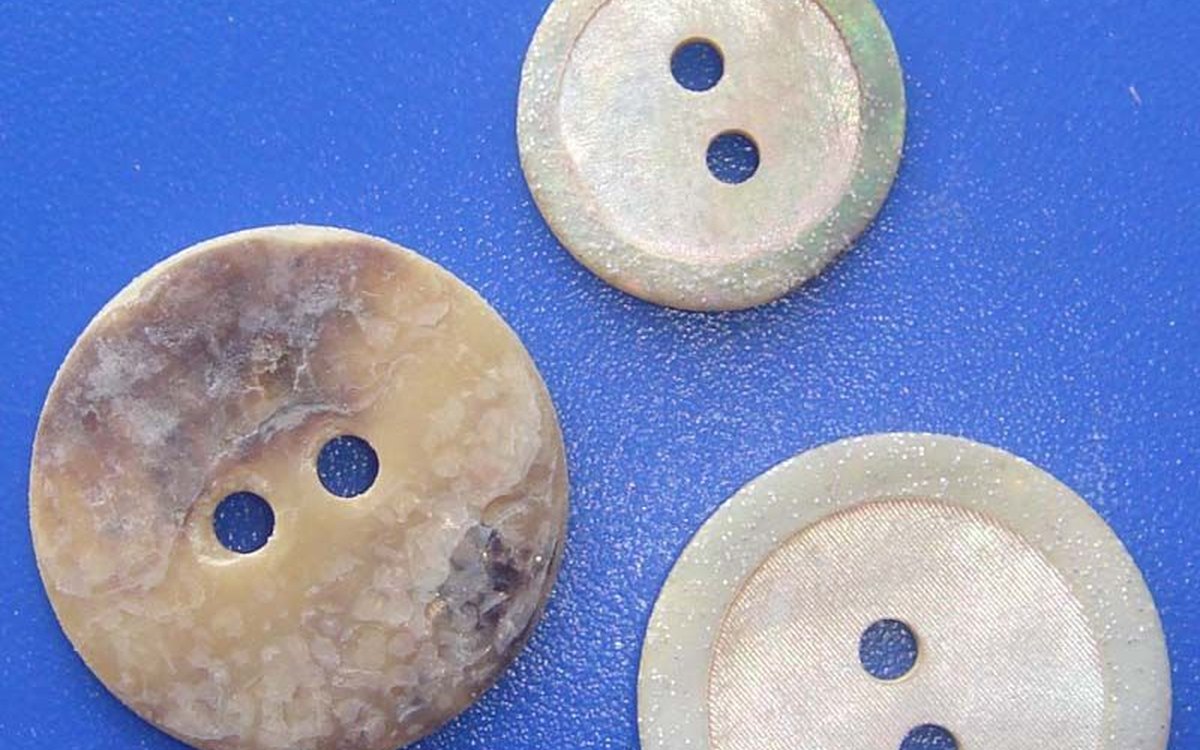
Domed shell buttons are mother of pearl and shell buttons with a convex, rounded face instead of a flat one. A gentle dome curves up towards the centre; a half-ball button is rounded like half a sphere; a ball button is almost fully round and is usually attached by a shank on the back. Some people call these balloon, bubble or round mother of pearl buttons. All of them share one quality: the curved surface catches light from every angle, so the nacre glows like a small pearl.
Because a curve needs height, domed shell buttons are cut from thicker pieces of shell than flat buttons of the same diameter. Below we compare button profiles and cover how domed shell buttons are made, where they suit, holes versus shank, sizing and sewing.
Button profiles explained
The profile is the side view of a button: how its surface rises and falls between the edge and the centre.
| Profile | Shape | Usual attachment | Character | Typical use |
|---|---|---|---|---|
| Flat | Even surface, same height edge to centre | 2-hole or 4-hole | Clean, minimal, sits close to the cloth | Shirts, blouses, fine knitwear |
| Rim | Raised border around a lower centre | 2-hole or 4-hole | Framed, traditional tailoring look | Jackets, cardigans, coats |
| Dome (convex) | Face curves gently up to the centre | 2-hole, 4-hole or shank | Soft, rounded, catches light | Blouses, dresses, knitwear, jackets |
| Half-ball | Strongly rounded, like half a sphere | Usually shank | Pearl-like, jewel-like presence | Bridal, eveningwear, cuffs, loop closures |
| Ball | Close to a full sphere | Shank | Bead-like, decorative | Loop closures, back fastenings, details |
| Bowl (concave) | Face dips towards the centre | 2-hole or 4-hole | Dished, holds shadow in the centre | Casual shirts, workwear-inspired pieces |
Flat, rim and dome are the core profiles for our shell buttons. Half-ball, ball and bowl shapes can be discussed on request where the shell allows, and every design is confirmed with samples.
Why domed shell buttons look so luminous
Mother of pearl shines because light reflects from many very thin layers of nacre. On a flat button you see that shimmer best when you tilt it towards the light. On a domed button there is always some part of the curve facing the light source, so a bright highlight sits on the surface while the iridescence rolls across the sides. The result is a soft, three-dimensional glow, close to the look of a pearl.
The rounded shape also feels pleasant to the touch and slides easily through a buttonhole or a fabric loop.
How domed and ball shell buttons are made
Every shell button starts as a blank cut from the shell. For a domed button the blank must be thick enough to contain the whole curve; the face is then ground into the dome and polished. A half-ball or ball shape needs even more height, so it can only be cut from the thickest parts of suitable shells.
- Not every shell suits every dome. Thick shells, such as larger pearl oyster shells used for mother of pearl buttons and the sturdy trocas shell, are generally better suited to pronounced domes. Thinner shells like akoya, and abalone, are normally made as flat 2-hole buttons.
- Height depends on size and shell. Exact sizes and thickness for each domed style are confirmed with samples.
Our shell button thickness guide explains how thickness is measured and why it matters for strength.
Holes or shank on a domed button?
A gently domed shell button can have 2 or 4 holes, just like a flat one. The holes are drilled through the curve, and the thread sits slightly lower in the centre.
The higher the dome, the more a shank makes sense. On a half-ball or ball button, holes through the face would interrupt the pearl-like surface and the thread would wear on the curve. A loop on the back keeps the face smooth. Our guide to shank shell buttons explains how shanks are attached and sewn.
- Soft dome: 2-hole, 4-hole or shank, depending on the look you want.
- Pronounced dome: 2-hole or shank are the usual choices.
- Half-ball and ball: shank.
Where domed shell buttons look best
Blouses and dresses
A row of small domed buttons down a silk or cotton blouse looks delicate and precious. On dresses, half-ball buttons on a back closure or a sleeve give a vintage-inspired, feminine finish.
Bridal wear
Long rows of white mother of pearl half-ball buttons with fabric loops are a classic bridal detail. More ideas are in our guide to shell buttons for wedding dresses.
Cardigans and knitwear
Domed buttons sit beautifully on fine and medium knits, where their rounded profile echoes the softness of the yarn.
Cuffs
On shirt and blouse cuffs, a small dome or half-ball looks like a cufflink without the extra hardware.
Evening jackets and tailoring
A domed black or white mother of pearl button adds quiet glamour to a dinner jacket, a velvet blazer or a cropped evening jacket.
Sizing domed shell buttons
Domed buttons are measured by diameter, in lignes (L) or millimetres. Our shell button range is typically 12L to 40L, depending on the shell (larger for abalone and river shell). Standard thickness is about 1.5–2.0 mm, and domed styles need more thickness than flat ones of the same diameter, so they are made as thicker buttons on request, mainly in mother of pearl and trocas.
- Measure the height as well. For domed and ball buttons, give the total height from back to top of the dome, plus the shank height if there is one.
- Allow for the curve in the buttonhole. A rounded button needs a slightly longer buttonhole than a flat one of the same diameter.
- Proportion. Small domes, around 14L to 20L, suit blouses, cuffs and bridal rows; larger domes suit knitwear and jackets.
For a full ligne to millimetre conversion, see our shell button size chart.
How to sew on domed shell buttons
- Mark the position opposite the centre of the buttonhole or loop.
- Use a strong, doubled thread in a colour that matches the fabric.
- For a domed button with holes, place a pin or matchstick on top of the button between the holes and sew over it.
- Remove the spacer, lift the button and wind the thread several times around the stitches underneath to form a firm thread shank.
- For a shank button, sew through the loop with the shank parallel to the buttonhole, and wind a short thread stem on thicker fabrics.
- Finish with a few small secure stitches on the back.
The thread shank lets the curved button sit on top of the closed buttonhole.
Caring for domed shell buttons
Shell is a durable natural material. Wash on a gentle cycle at moderate temperature with the garment turned inside out, use mild detergent, and press around the buttons rather than over them. A pressing cloth helps, because domes stand higher than flat buttons.
FAQ
What is a domed button?
A domed button has a convex face that curves upwards towards the centre, rather than a flat surface. It can have holes or a shank on the back.
What are balloon or bubble mother of pearl buttons?
These are common names for strongly rounded mother of pearl buttons, such as half-ball or ball shapes. They usually have a shank on the back so the rounded face stays smooth.
Are domed shell buttons thicker than flat ones?
Yes. A domed button is cut from a thicker shell blank so it can hold the curve.
Can domed shell buttons have 4 holes?
Gently domed buttons can have 2 or 4 holes. Pronounced domes usually have 2 holes or a shank, and half-ball and ball buttons have a shank.
Which shells are used for domed buttons?
Thicker shells such as mother of pearl and trocas generally suit domes best. Akoya and abalone are made with 2 holes, round or in fancy shapes, and not with 4 holes.
Find your domed shell buttons
Brands and garment makers can request samples and a price offer for domed, half-ball and ball shell buttons on our wholesale page. Designers, tailors and makers can browse ready-to-order buttons in our online shop.
Related guides
 What Colour Is Mother of Pearl? Nacre Shades from White to Black
Mother of pearl is best known as iridescent white, yet nacre ranges from cream and gold to grey, black and peacock. The natural colours...
Read →
 Mother of Pearl Button Jewellery and Crafts: Earrings, Bracelets and More
How to make earrings, bracelets, necklaces, brooches and cards with mother of pearl buttons – which sizes and shells to choose and how to...
Read →
 Mother of Pearl in Musical Instruments: Saxophone Keys, Guitar Inlays and Bows
From saxophone key touches to guitar inlays and violin bow frogs: where mother of pearl and abalone appear on musical instruments and how the...
Read →
