
2-Hole vs 4-Hole Shell Buttons: Which to Choose?
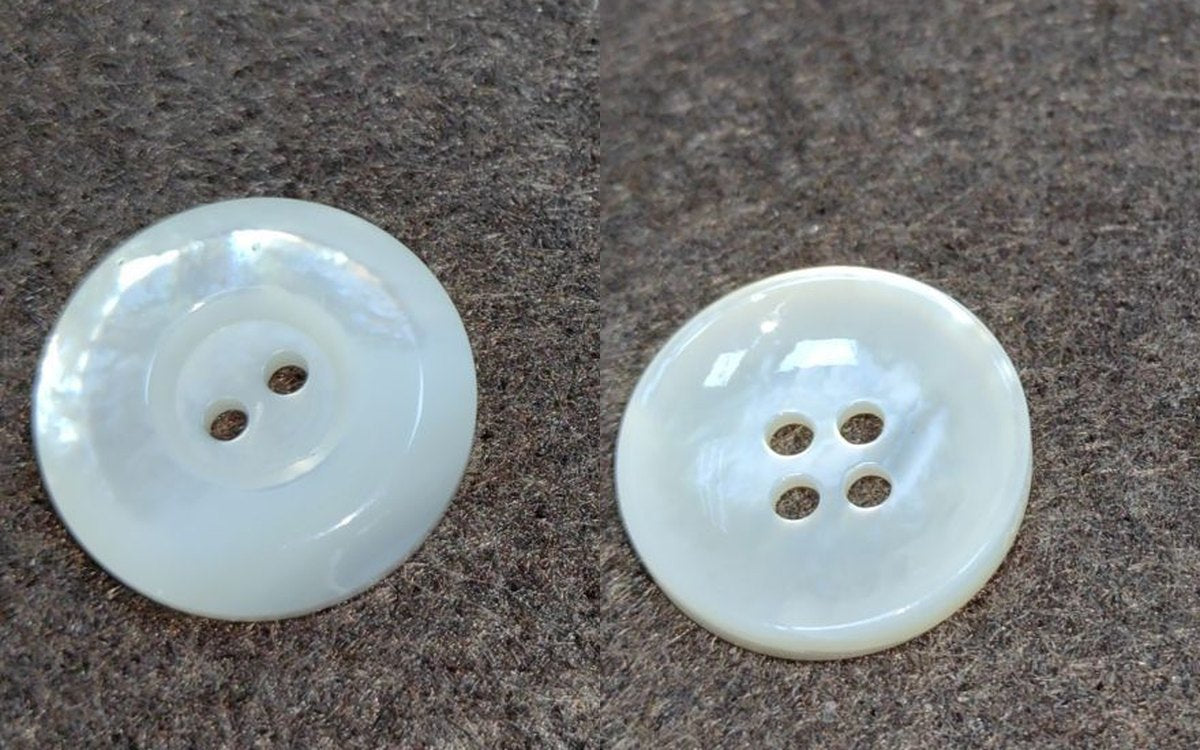
Choose 4-hole shell buttons when you want the classic shirt look and maximum hold: the thread is spread over four points, so the button sits flat and stable on shirts, polos, cardigans worn every day and jackets. Choose 2-hole shell buttons for a lighter, minimal look that shows more of the shell, ideal for blouses, dresses and fine knitwear, and the only hole type for akoya and abalone buttons.
There is also a third option: the shank button, with a loop on the back and a clean face. In this guide we compare 2-hole vs 4-hole shell buttons on look, holding strength, sewing methods, typical garments and sizes, and show where a shank button is the better answer.
2-hole vs 4-hole shell buttons at a glance
| Feature | 2-hole shell buttons | 4-hole shell buttons |
|---|---|---|
| Look | Light and minimal; more of the shell face is visible | Classic tailored look; the stitching can become a design detail |
| Thread path | One line of stitches between two holes | Two bars, a cross or a square of stitches over four holes |
| Holding | Secure for light and medium fabrics | Very stable; thread tension is shared by four holes |
| Movement | Can pivot slightly along the line of thread | Sits flat and steady in the buttonhole |
| Sewing | Quick by hand or machine | Standard on shirt button-sewing machines; more stitching by hand |
| Typical garments | Blouses, dresses, fine knits, children's wear, bridal, statement buttons | Dress shirts, polo shirts, cardigans, jackets, workwear-inspired pieces |
| Typical shells | All shells except brown MOP; akoya and abalone are made with 2 holes only | White, yellow, black and brown mother of pearl (brown MOP only as a rim 4-hole), trocas, river shell |
The look: how holes change a button
Holes are part of the design. A 2-hole shell button has only two small openings, so the face reads as one calm surface of nacre. That is why the colourful faces of abalone and the soft pink-silver reflections of akoya are made with 2 holes only, round or in fancy shapes: nothing interrupts the shell, and these thinner shells are best suited to two holes. On a delicate blouse, a 2-hole button feels light and discreet.
A 4-hole shell button has a more structured, familiar look, the one most people picture on a fine shirt. The four holes create a small square in the centre and the thread pattern adds a quiet detail: two neat bars on a dress shirt, or a cross that looks slightly more casual or decorative. On a white mother of pearl shirt button, the iridescence still frames the holes beautifully.
Holding strength and how the button sits
Both types hold well when they are sewn properly; the difference is in how the load is shared. On a 2-hole button all the tension runs through one line of thread between two holes. That is perfectly secure on light and medium fabrics, but the button can rock slightly along the stitch line.
On a 4-hole button the same pull is spread over four holes and two lines of thread. The button sits flatter, stays aligned in the buttonhole and copes well with garments that are fastened and unfastened many times a day, such as shirts, polos and everyday cardigans. If one line of thread wears, the other usually keeps the button in place until it can be repaired.
For heavy fabrics, both types benefit from a thread shank: a few turns of thread wrapped under the button so it stands slightly away from the cloth and the buttonhole closes without strain.
Sewing methods for 2-hole and 4-hole buttons
The way the thread crosses the button affects both the look and the hold. These are the most common methods:
- 2-hole, straight: the thread runs between the two holes, usually parallel to the buttonhole so the button lies straight when fastened.
- 4-hole, parallel bars (=): two separate bars of stitches. This is the usual choice on shirts, neat and flat.
- 4-hole, cross (×): the thread crosses diagonally between opposite holes. It is very secure and gives a decorative, slightly casual look, popular on knitwear and workwear-inspired pieces.
- 4-hole, square: the thread runs around all four sides, creating a small box. It is a decorative option for designers who want the stitching to be seen.
- 4-hole, crow's foot or arrow: three of the four holes are linked to one, so the stitches form an arrow or bird's-foot shape. It is a hand-sewn detail often associated with bespoke shirtmaking.
Coloured thread turns any of these into a small design signature, for example navy thread on white mother of pearl. Step-by-step instructions, thread advice and tips to avoid chipping are in our guide on how to sew on shell buttons.
Which garments use 2-hole or 4-hole buttons?
| Garment | Usual choice | Why |
|---|---|---|
| Dress shirts | 4-hole | Flat, stable hold for daily wear and machine sewing |
| Blouses | 2-hole or 4-hole | 2-hole for a delicate look, 4-hole for crisp shirting |
| Polo shirts | 4-hole or 2-hole | Small, secure buttons on a short placket |
| Fine knitwear and cardigans | 2-hole or 4-hole | 2-hole shows more shell; 4-hole sits flatter on everyday cardigans |
| Chunky knitwear | 4-hole or shank | Spreads the load or lifts the button above the thick knit |
| Jackets and blazers | 4-hole or shank | Classic tailoring look; shank for a clean statement face |
| Coats | 4-hole or shank | Large, thick buttons that need a strong attachment |
| Dresses and bridal wear | 2-hole or shank | Light look; shank buttons suit loops and back closures |
For more detail on specific garments, see our guides to mother of pearl shirt buttons and shell buttons for cardigans.
Sizes for 2-hole and 4-hole shell buttons
Our shell buttons typically run from 12L to 40L (about 7.6 to 25.4 mm), depending on the shell (larger for abalone and river shell). Flat 2-hole and rim 4-hole are the most popular styles in white, yellow and black mother of pearl, trocas and river shell; brown mother of pearl is made as a rim 4-hole from 14L to 32L, and abalone goes up to 120L with 2 holes. Typical choices:
- 12L–18L (about 7.6–11.5 mm): shirts, collars, cuffs, polos, blouses and children's wear. 4-hole is the usual shirt-front choice; 2-hole suits delicate fabrics.
- 18L–24L (about 11.5–15 mm): blouses, dresses, cardigans and pocket flaps, in either type.
- 24L–40L (about 15–25 mm): knitwear, jackets and coats, most often 4-hole or shank; large 2-hole abalone makes a striking statement.
On small buttons, the hole spacing matters for machine sewing, so send a reference button or the hole distance with your order. Our button size chart converts every ligne size to millimetres and inches, and the thickness guide explains how thickness changes with size.
The third option: shank shell buttons
A shank button has no holes through the face. Instead, a loop or small stem on the back carries the thread, so the front shows an uninterrupted surface of shell, ideal for engraved logos, domed shapes and statement buttons. The shank also lifts the button slightly above the fabric, which helps on thick coats, knitwear and button loops on dresses. Read our full guide to shank shell buttons for sizes, sewing and care.
How to choose in three questions
- What should people see? If the shell itself is the focus, choose 2-hole or shank. If you want a classic tailored detail, choose 4-hole.
- How hard will the button work? For garments fastened every day or sewn on automatic machines, 4-hole is the safe standard. For light fabrics, 2-hole is ideal.
- How thick is the fabric? On heavy fabrics, add a thread shank to a 2-hole or 4-hole button, or choose a shank button.
When in doubt, order samples of both types and sew them onto your fabric; seeing them side by side usually makes the choice clear.
FAQ
Are 4-hole buttons stronger than 2-hole buttons?
A 4-hole button spreads the thread tension over four holes, so it sits more stably and copes well with frequent use. Well-sewn 2-hole buttons are also secure on light and medium fabrics.
Do shirts use 2-hole or 4-hole buttons?
Most dress shirts use 4-hole buttons sewn with two parallel bars. Some blouses and casual shirts use 2-hole buttons for a lighter look.
Should I sew a 4-hole button in parallel or crossed?
Parallel bars are the classic, flat choice for shirts. A cross is very secure and slightly more decorative, popular on knitwear and casual garments.
Why are abalone and akoya buttons always 2-hole?
Akoya and abalone are made with 2 holes only, round or in fancy shapes. The shells are relatively thin, so two holes suit them best, and the colourful or softly iridescent face stays open and uninterrupted.
When should I choose a shank button instead?
Choose a shank when you want a clean face without holes, for example for logos or domed buttons, or when the button must stand above a thick fabric or close a loop.
Find your shell buttons
Compare our 2-hole shell buttons, 4-hole shell buttons and shank shell buttons. Brands and garment makers can request samples and a price offer on our wholesale page, and designers, tailors and makers can order smaller quantities in our online shop.
Related guides
 Mother of Pearl Button Jewellery and Crafts: Earrings, Bracelets and More
How to make earrings, bracelets, necklaces, brooches and cards with mother of pearl buttons – which sizes and shells to choose and how to...
Read →
 Shell Buttons for Christening Gowns and First Communion Dresses
Small white mother of pearl buttons for christening gowns, baptism suits and first communion dresses: sizes, styles and safety.
Read →
 Shell Buttons for Historical Costume, Theatre and Period Dress
How costume makers and theatre workshops use mother of pearl buttons for period dress, from waistcoats to blouses and underwear.
Read →
