
White, Black and Smoked Mother of Pearl Buttons
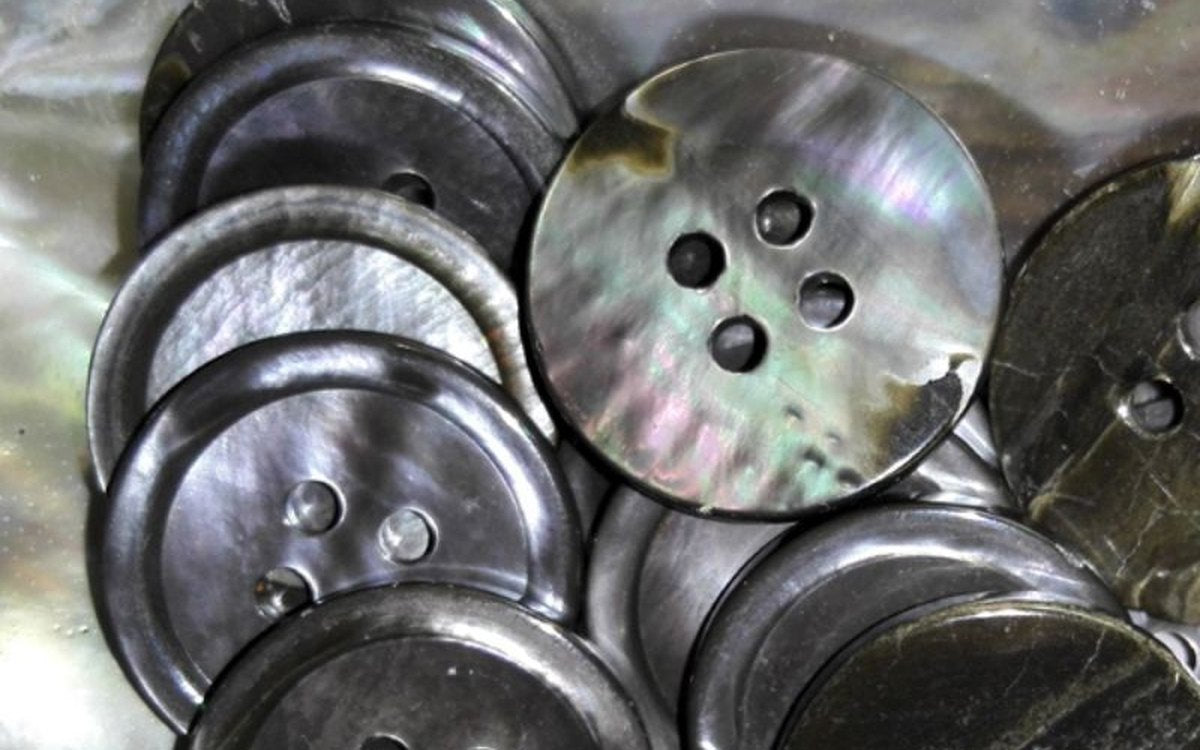
White, black and smoked mother of pearl buttons are all natural shell, cut from cultured pearl oysters. White mother of pearl comes mainly from the silver-lip oyster farmed in Australia, the Philippines or Indonesia and gives bright, silvery buttons for shirts. Black mother of pearl comes from the black-lip oyster of Tahiti, with charcoal and peacock tones; smoked grey and smoked brown buttons are softer tones created by a separate smoking treatment.
So when you see "white MOP", "black MOP", "Tahiti MOP" or "smoked shell buttons" on a specification, you are looking at genuine shell, from a clean bright white to a deep, moody lustre. This guide explains where each colour comes from, how naturally coloured and toned buttons differ, how to read them by eye, and which garments wear white, black and smoked mother of pearl best.
White mother of pearl buttons
White mother of pearl is cut from the nacre of large pearl oysters, above all the silver-lip form of Pinctada maxima. Our white and yellow mother of pearl comes from cultured shells farmed in Australia, the Philippines or Indonesia, all ocean shells. The nacre is bright and clean, with a soft silver iridescence rather than strong rainbow colours, and the thick shell yields substantial buttons. Read more in our guide to Australian mother of pearl.
White on both sides, or white with skin back
White MOP buttons come in two main versions. Buttons that are white on both sides, with no natural skin left on the back, are cut from the cleanest parts of the shell and are the most expensive white grade. Buttons with a white top and natural skin on the back keep a little of the shell's outer surface on the reverse, which many makers like as a quiet sign of natural material.
Bright white and off-white
Natural nacre is never one flat white. Sorting separates bright, silvery white from slightly warmer off-white and cream tones, which come from areas nearer the golden edge of some shells. Bright white suits crisp white poplin; off-white sits more softly on ivory, ecru and natural linen.
White MOP on white shirts
White mother of pearl is the classic button for a white dress shirt. On the placket it reads as pure white that glows a little when the light moves, and a thicker button adds a pleasant weight. Shirt fronts and cuffs typically use 16L–18L, with 14L on collar points. Our shirt buttons guide covers sizes and thickness.
Where black mother of pearl gets its colour
The black-lip oyster is farmed in the warm lagoons of French Polynesia and the wider Pacific, where it is grown for Tahitian pearls. Once the pearl harvest is done, the shell itself becomes the raw material for buttons, so every black mother of pearl button is a by-product of cultured pearl farming. Our black MOP comes from Tahiti.
The shell has a dark rim, the "black lip" that gives the oyster its name, and a lighter, silvery-grey centre. Between them sits a band of mixed tones. A button cutter works across these zones, and that is why one shell can yield very dark buttons, mid-grey buttons and lighter smoky pieces. Sorting by tone after polishing is what turns this natural range into consistent batches.
The tones of white, black and smoked mother of pearl
| Tone | What it looks like | Typical use |
|---|---|---|
| Bright white | Clean, silvery white with soft iridescence | White dress shirts, bridal, white linen |
| Off-white / cream | Slightly warmer white, gentle and calm | Ivory and ecru fabrics, natural linen, knitwear |
| Natural black | Deep charcoal with green, blue and violet flashes | Tuxedo shirts, black dresses, dark coats |
| Natural mixed grey | Silvery grey from the lighter zones of the black-lip shell, with soft iridescence | Grey and navy suiting, shirts in mid tones |
| Smoked grey / smoked brown | Grey to grey-brown, created by a smoking tone treatment; warm and understated | Autumn jackets, flannel, denim, knitwear |
| Mixed / natural variation | Each button a little different, from grey to bronze | Casual shirts, workwear, artisanal pieces |
| Sprayed colours | An even colour sprayed onto the top side, matched to a Pantone reference | Collections that need one exact shade across many garments |
Black MOP comes in natural black, natural mixed grey, smoked grey, smoked brown and sprayed colours; white MOP in white/white, white/yellow, smoked grey, smoked brown and sprayed colours. Sizes typically run from 12L to 40L (about 7.5–25 mm), with a standard thickness of about 1.5–2.0 mm and thicker buttons on request.
Natural colour and toned buttons: how they differ
There are three ways a dark shell button can reach your garment, and all three are genuine shell. The same logic applies to white shell, which can be smoked or given a sprayed colour when a brand needs one.
Natural colour
The button is cut from a dark area of the black-lip shell and simply polished. The colour belongs to the nacre itself, so it has depth: you see layers of tone beneath the surface, and the shimmer shifts from green to blue to pink as you turn it. No two buttons are identical.
Smoked tone
Smoking is a separate tone treatment that gives white or black shell an even grey or brown tone across a batch. (The natural mixed grey of the black-lip shell is a different thing: it is simply cut from the lighter zones.) A smoked button keeps the iridescence of the nacre underneath, so it reads as a soft, veiled version of the shell's own glow.
Sprayed colour
Coloured shell buttons are often called dyed, but today the colour is sprayed onto the top side of the button and can be matched to a Pantone reference. A sprayed finish gives a more uniform colour, which is useful when a brand wants every button on every garment to match. We cover the process in detail in our guides to dyed (sprayed) shell buttons and coloured shell buttons, so here we focus on the natural dark shell.
How to tell natural black mother of pearl by eye
You do not need a laboratory to read a dark shell button. A few quiet observations tell you a lot:
- Depth of colour. Natural black MOP looks layered, as if the colour sits under a clear surface. Tilt it under a lamp and bands of light travel across it.
- Play of colour. Look for green, blue, violet and bronze flashes. These come from the way light passes through thin layers of nacre and are characteristic of the black-lip shell.
- Variation within a batch. Lay twenty buttons side by side. Natural colour shows gentle differences from button to button; an evenly sprayed batch looks more uniform.
- The back and the edge. On the reverse or along the polished edge you can often see the natural grain and banding of the shell. Some styles keep a little natural skin on the back.
- Hole walls. Inside the drilled holes, the shell's own colour shows. On a sprayed button the hole wall and the back show the natural shell, because the colour sits on the top side.
Our guide on recognising genuine shell buttons explains the cool touch, weight and light test that apply to every shell.
Garments that wear black and smoked MOP best
Autumn and winter jackets
Smoke and grey shell buttons are a natural partner for tweed, flannel, corduroy and wool jackets. They pick up the heather tones of the cloth and add a quiet glint without the brightness of white shell. Many tailors use 32L on the front and 24L on the cuffs; see our jackets and blazers guide for proportions.
Dark shirts and evening wear
On black, navy, charcoal or burgundy shirts, natural black mother of pearl looks rich and deliberate. On a tuxedo shirt, a black MOP front with a subtle peacock shimmer is a classic evening detail. Shirt fronts typically use 16L–18L.
Knitwear and cardigans
Grey and smoke shell buttons suit charcoal, oatmeal, camel and navy knits. Their soft colour sits comfortably on textured yarn, and 4-hole styles in 20L–24L are a popular choice. Our knitwear shell buttons collection shows typical styles.
Coats and outerwear
Large black mother of pearl buttons, often 36L–40L, give a dark wool coat a refined finish. Shank styles let the button sit slightly away from thick cloth, while 4-hole buttons keep a classic tailored look. See our coat shell buttons.
Styles, attachment and finishing
White, black and smoked mother of pearl is most popular as flat 2-hole and rim 4-hole buttons; other styles, fancy shapes and shank buttons (a self shank on white MOP, or a metal leg shank) are possible on request. The dark shell is especially beautiful with a polished rim, where the edge reveals lighter bands of nacre and creates a natural frame around the holes.
Logo laser engraving shows well on black MOP, because the engraved area turns a lighter grey against the dark face. It is a refined way to brand a coat or jacket button. As always, we produce samples before bulk so you can approve colour, size and engraving on your own fabric.
Caring for white and dark shell buttons
White, black and smoked mother of pearl need the same gentle care as any shell. Wash at moderate temperatures, iron from the reverse or around the buttons, and close buttons before machine washing. Smoked and sprayed tones keep their best colour with mild detergent and without bleach. Natural black colour is stable, because it is the shell's own pigment. Our care guide has more detail.
FAQ
Where does white mother of pearl come from?
Our white mother of pearl comes from cultured pearl oysters, mainly the silver-lip Pinctada maxima, farmed in Australia, the Philippines or Indonesia.
Is black mother of pearl naturally black?
Yes. It comes from the black-lip pearl oyster, whose nacre grows in natural dark tones. Natural mixed grey, smoked grey, smoked brown and sprayed versions are also available.
What is Tahiti MOP?
It is the trade name for black mother of pearl from the black-lip oyster, Pinctada margaritifera, farmed in French Polynesia for Tahitian pearls.
What is the difference between smoke and black shell buttons?
Black is the deepest natural tone. Smoked grey or brown is a softer tone created by a smoking treatment that keeps the shimmer of the nacre beneath.
Which garments suit smoked mother of pearl buttons?
Autumn jackets, flannel and tweed, denim, grey suiting and knitwear in charcoal, navy or camel.
Choose your white, black or smoked shell
Explore the full family on our mother of pearl buttons page. Request samples and a price offer on our wholesale page, or browse shell buttons in our online shop.
Related guides
 Shell Buttons for Coats: Sizes, Thickness and Shells for Outerwear
A guide to mother of pearl and shell buttons for coats and outerwear – sizes, thickness, shank or 4-hole, which shells suit which coats,...
Read →
 Shell Buttons for Bags, Cushions and Home Textiles
Mother of pearl buttons for bags, cushion covers, bed linen and home textiles: sizes, styles and practical tips.
Read →
 Shell Buttons in Bespoke Tailoring: Sleeve Buttons, Working Cuffs and Kissing Buttons
How tailors use mother of pearl buttons on jacket sleeves, working cuffs and waistcoats, with sizes and placement notes.
Read →
